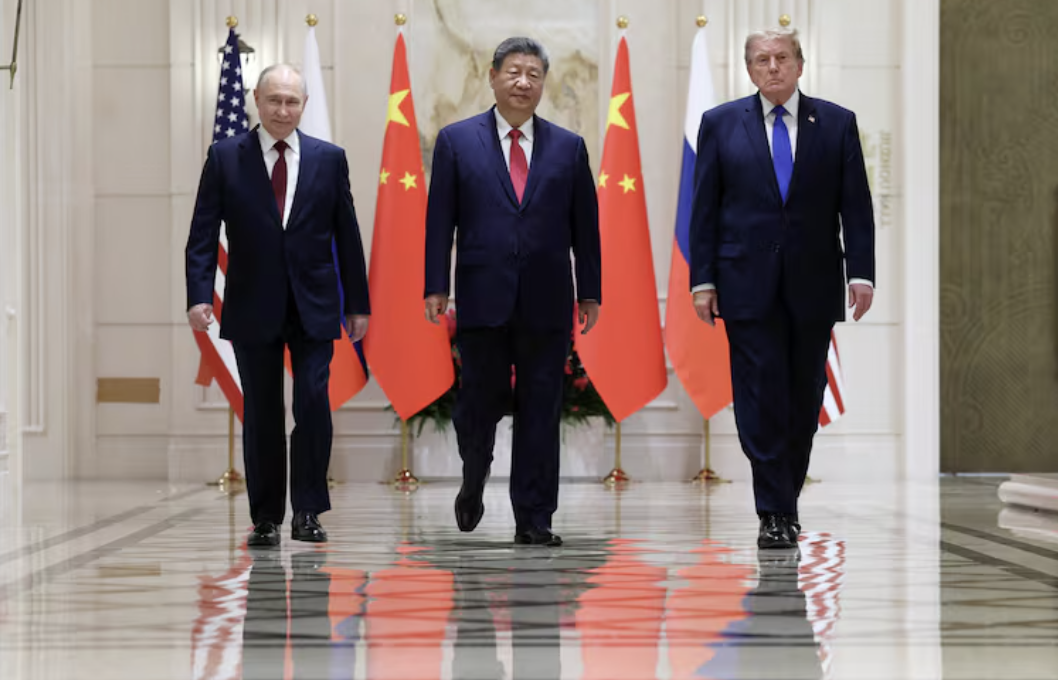
The Trump-Xi-Putin summit in Shenzhen produced remarkably little. No settlement on Ukraine. No agreement on Taiwan. No grand bargain on trade. Even the commitment to increase global fuel supply failed to produce a meaningful reaction in energy markets. And yet the meeting mattered. Its significance was not in what the three leaders agreed. It was in the image they chose to create: the presidents of the United States, China and Russia sitting together as if the management of international affairs once again belonged principally to great powers. The comparison with Yalta was inevitable. But Shenzhen was not Yalta.
At Yalta, Roosevelt, Churchill and Stalin represented an alliance that had defeated a common enemy and possessed enough military power to determine much of the post-war settlement. Trump, Xi and Putin share neither a common enemy nor a common project. Their interests frequently conflict; Russia is economically far weaker than either the United States or China, and the international system is much more fragmented than it was in 1945. The difference, however, should not obscure the direction of travel. The old order was built around institutions designed to constrain power. The emerging one increasingly assumes that power comes first and institutions follow. Trump called for curbing what he described as rogue global institutions. Putin used his presence to demonstrate that Western attempts to isolate Russia had failed. Xi presented the three powers as countries carrying a particular responsibility for global stability. None of this created a coherent strategic alliance. It did something subtler. It normalised the idea that the world’s largest powers should discuss global problems directly with one another and that smaller countries may subsequently have to adapt to whatever framework emerges. That is the real geopolitical shift.
For Russia, the benefit is obvious. Putin did not need a substantive agreement. Simply sitting beside the American and Chinese presidents restored something Moscow has sought for years: recognition as one of the powers entitled to negotiate the architecture of international security. Russia’s economy may be less than one-seventh the size of China’s and increasingly dependent on Beijing, but nuclear weapons, energy and geography continue to give Moscow a geopolitical weight far greater than its economic size. Putin therefore gains from the format itself.
China’s calculation is more sophisticated. Xi does not need a formal alliance with either Russia or the United States. What China needs most urgently is time. Washington has intensified restrictions on China’s access to advanced AI semiconductors, while Beijing retains its own leverage through critical minerals such as gallium, germanium and antimony. The temporary suspension of Chinese export restrictions is approaching expiry, while further American measures, including restrictions on Chinese cars, remain under discussion. Against that background, Xi’s extraordinary hospitality towards Trump was not sentimental diplomacy. It was risk management. China appears to have concluded that Trump’s preference for personal negotiation may offer a better opportunity to slow the technological confrontation than dealing exclusively through the wider US institutional system. That explains the unusual warmth. Trump called Xi a friend. Xi praised Trump’s role in stabilising relations. Their meeting lasted longer than planned and produced promises to work towards strategic stability and increased cooperation in areas including AI and drugs. But none of that changes the underlying conflict. The semiconductor war is not primarily about trade. It is about future power. Who controls the most advanced chips controls a critical part of AI development. Who dominates AI potentially gains advantages in productivity, defence, intelligence and industrial capacity. No personal relationship can eliminate that competition. Indeed, the Chinese analysis appears to recognise precisely this point: preserve the relationship with Trump because the broader American system may become more restrictive when the new Congress takes office.
The summit therefore revealed something fundamental about Trump’s foreign policy. It is transactional rather than institutional. Trump appears more comfortable negotiating directly with individual leaders than relying on permanent frameworks. This creates opportunities for China and Russia because personal diplomacy can sometimes soften institutional constraints. But it also creates enormous uncertainty. A relationship based on the chemistry between leaders is easier to improve quickly. It is also easier to reverse. That is why the friendliness in Shenzhen should not be mistaken for a new strategic equilibrium. The United States still wants to restrict China’s access to the most advanced technology. China still seeks to reduce American technological leverage. Russia still wants Western acceptance of its claims in Ukraine. Washington and Beijing remain competitors across trade, technology, military power and influence in Asia. What has changed is the mechanism through which these conflicts are increasingly managed. Negotiation is moving upwards. Institutions are becoming weaker. Leadership relationships are becoming more important. And transactional bargains are replacing some of the predictability previously provided by alliances and international rules.
This is precisely why the reaction of the middle powers matters. Australia, Canada, South Korea and others used the APEC summit to argue for something very different: more diversified partnerships, stronger domestic capacity, secure access to energy and critical minerals, and less dependence on any single great power. That is not an alternative ideology. It is a survival strategy. If the world is moving towards direct bargaining between Washington, Beijing and Moscow, medium-sized countries cannot assume that their interests will always be protected by the institutions created after 1945. They need options.
Europe faces exactly the same problem. Ukraine has already discovered the danger of depending on American intelligence, weapons and satellite infrastructure when US strategic priorities can change rapidly. Europe’s energy crisis has demonstrated the cost of excessive dependence on external suppliers. The semiconductor confrontation shows the same vulnerability in technology. Critical minerals will increasingly do the same for industry. Strategic autonomy therefore does not mean isolation. It means reducing the number of decisions another country can make on your behalf. That may become the defining principle of the next international order.
The paradox is that the three great powers themselves are pursuing exactly the same objective. China wants technological autonomy from the United States. Russia wants economic and strategic autonomy from the West. The United States wants to reduce dependence on Chinese supply chains. Everyone is speaking about cooperation while simultaneously preparing for a world in which cooperation cannot be guaranteed. This is why Shenzhen matters despite producing so little. It was not the creation of a new Yalta system because the three powers do not trust one another enough to divide the world coherently, and the rest of the world retains too much agency to accept such a settlement quietly. But it was a rehearsal for something else. A world in which great powers negotiate more directly. A world in which economic relationships become instruments of geopolitical leverage. A world in which technology, energy and critical minerals matter as much as armies. And a world in which smaller countries increasingly discover that sovereignty depends not simply on having a flag, but on having alternatives. Shenzhen did not divide the world into spheres of influence. It showed why everyone else is already preparing for the day when someone tries.